



 Deutsch
Japanese Saw 200 mm
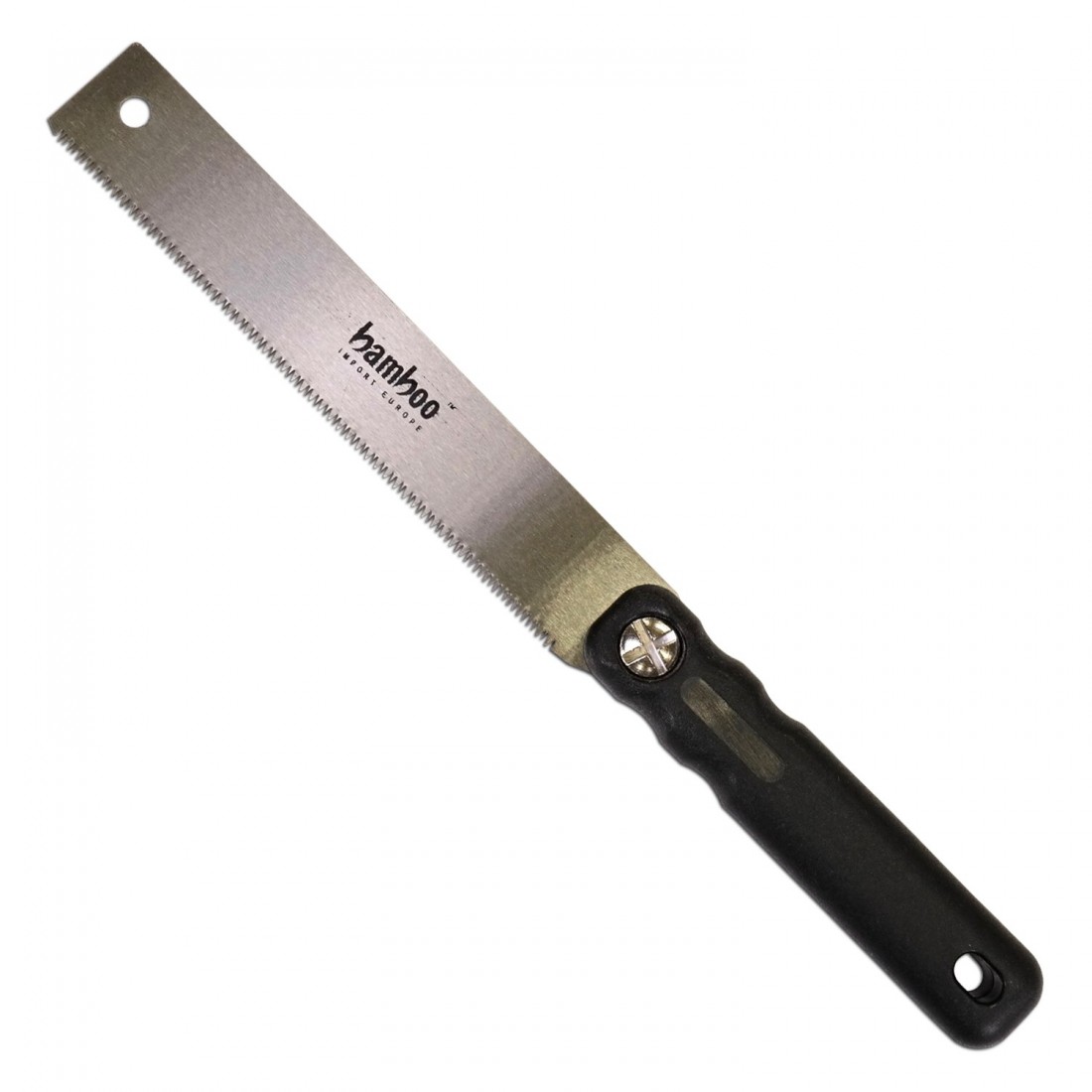
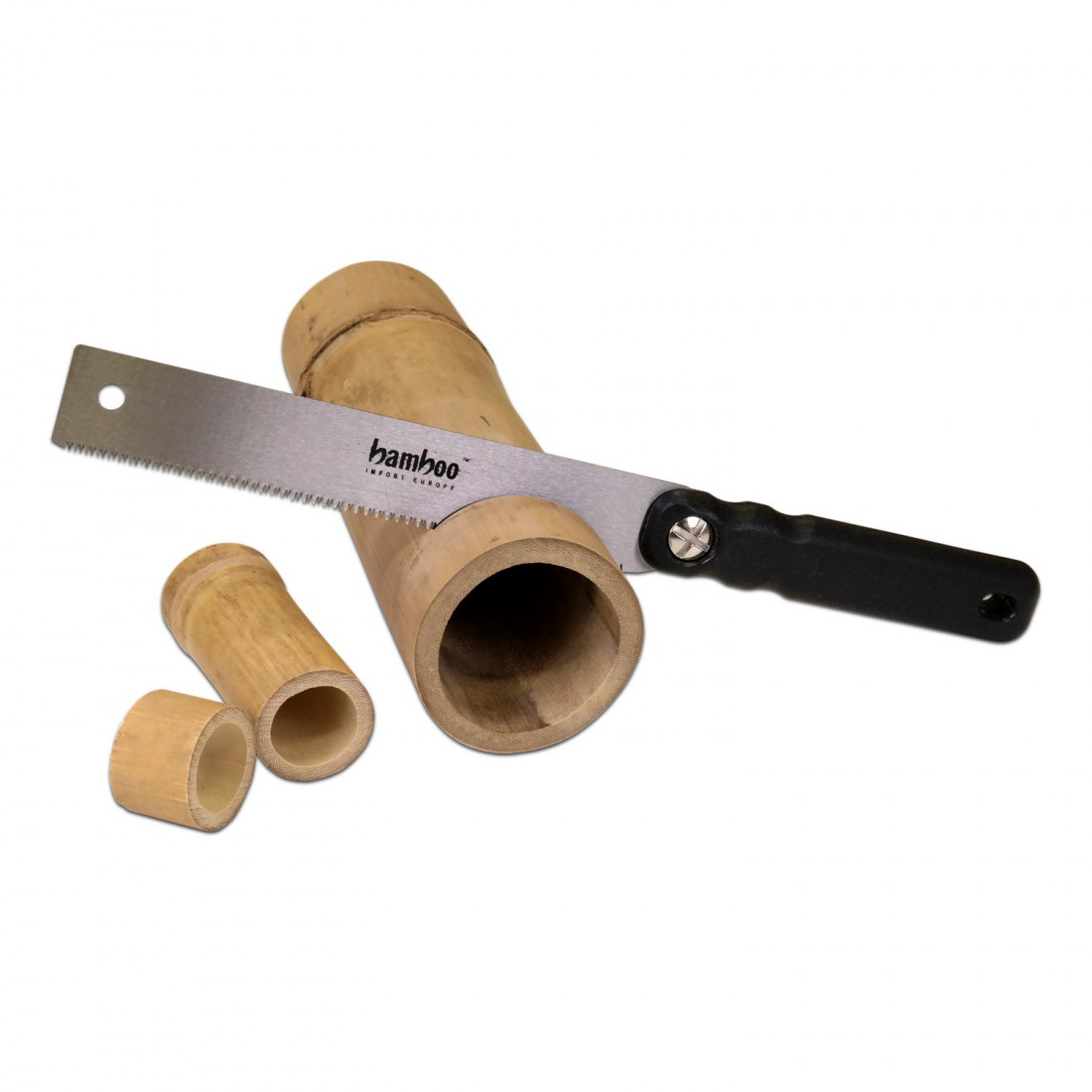
This powerful Japanese saw, known as a “kataba saw”, is a versatile tool ideally suited for cutting bamboo. Its thin blade, with 3-sided trapezoidal teeth, makes it quick and easy to cut hard bamboo canes, poles and slats.
For professional woodworkers, a Japanese saw is an essential part of the toolbox, as it delivers a perfect cutting result. Thanks to its special hybrid teeth, this all-purpose saw allows for extremely precise cutting.
DETAILS
| Total length: | 350 mm |
| Blade length: | 200 mm |
| Blade width: | 35 mm |
| Blade thickness: | 0,5 mm |
| Cut: | 0,8 mm |
| Teeth: | TPI (teeth per inch) |
| Tooth angle | 1,7 mm |
| weight: | 86° |
| Steel type: | Carbon steel (stainless) |
| Handle | Plastic |
Pull
Japanese saws look very different from Western saws. The blades of a Japanese saw are much thinner and more flexible, and their construction is different. The biggest difference, however, is that Japanese saws are pull saws. This means a Japanese saw does its work on the pull stroke, rather than being pushed through the bamboo like a Western saw.
Fine penetration is minimized, as the kerf is only a fraction wider than the saw blade itself. The minimal set of the saw teeth ensures a perfectly smooth cut. In addition, Japanese saws are also suitable for ripping or cross-cutting ordinary wood.
ADVANTAGES
- The pull-stroke action has the advantage that the saw blade is tensioned so that it does not vibrate during the cut.
- Thanks to the thin blade and the extremely sharp, trapezoidal saw teeth, it is very easy to make extremely fine cuts without any sanding. The result is an extremely thin cut with great precision.
- The pull stroke also has the great advantage of requiring much less force. A pull saw needs up to three times less force than a push saw. So not only do you work much faster, it also takes less strength and effort.
- The thin blade of a Japanese saw removes wood or bamboo much more efficiently, producing less sawdust than an ordinary Western saw.
- Finally, a Japanese saw gives you much more control, allowing you to cut in a straight line.
INSTRUCTIONS
- Cutting with a Japanese pull saw starts at the back, near the handle. Hold the saw where you want to cut and use your thumb (carefully) to guide the blade until it bites into the bamboo. Then slowly pull the saw towards you.
- Let the saw do the work and don’t apply too much pressure. This can sometimes be difficult if you are used to the Western grip, where pressure is required.
- When making your first strokes, don’t make the mistake of cutting too fast or pressing harder. First make a straight line. This way you ensure a perfect result, and the saw will last much longer.
- Practice finding the best cutting angle. We recommend an almost horizontal motion, since this gives you the most contact with the bamboo as the cut progresses, while the saw can still be held at an angle.
- Make the sawing motion smooth, without pressing and without focusing too much on the pull stroke itself. The result is a nice, clean cut with every stroke.
37 €