



 Deutsch
Blog / Tips
Amazing facts about bamboo
Jun
Bamboo’s popularity is increasing year after year, and many incredible stories are told about this plant. But are the things people say about bamboo really true? Does it really grow 1 metre a day? Does bamboo originate from China? On this page, you’ll find all the real facts about bamboo!
1. What is the origin of the word “bamboo”?
The origin of the word bamboo comes from the Malay word “Mambu “. Malay is the national language of Malaysia and Indonesia. At the end of the 16th century (1590-1600), the Dutch named it “Bambes “, after which it received itsbotanical name “Bambusa “.

Bamboo bonfire
Some claim that the original Malay word was “Bambu “, which resembles the sound it makes when bamboo explodes in an open fire. When bamboo is heated, the air in the sealed hollow internode chambers expands, causing anexplosive “bam-boom” sound .
2. Is bamboo a tree or a grass?
Bamboo belongs to the Bambusoideae subfamily within the perennial evergreen grass family Poaceae (Gramineae). It was German botanist Carl Kunth who first published his taxonomic findings in 1815.Of all grasses, bamboo is the largest and the only one that can diversify into forest .
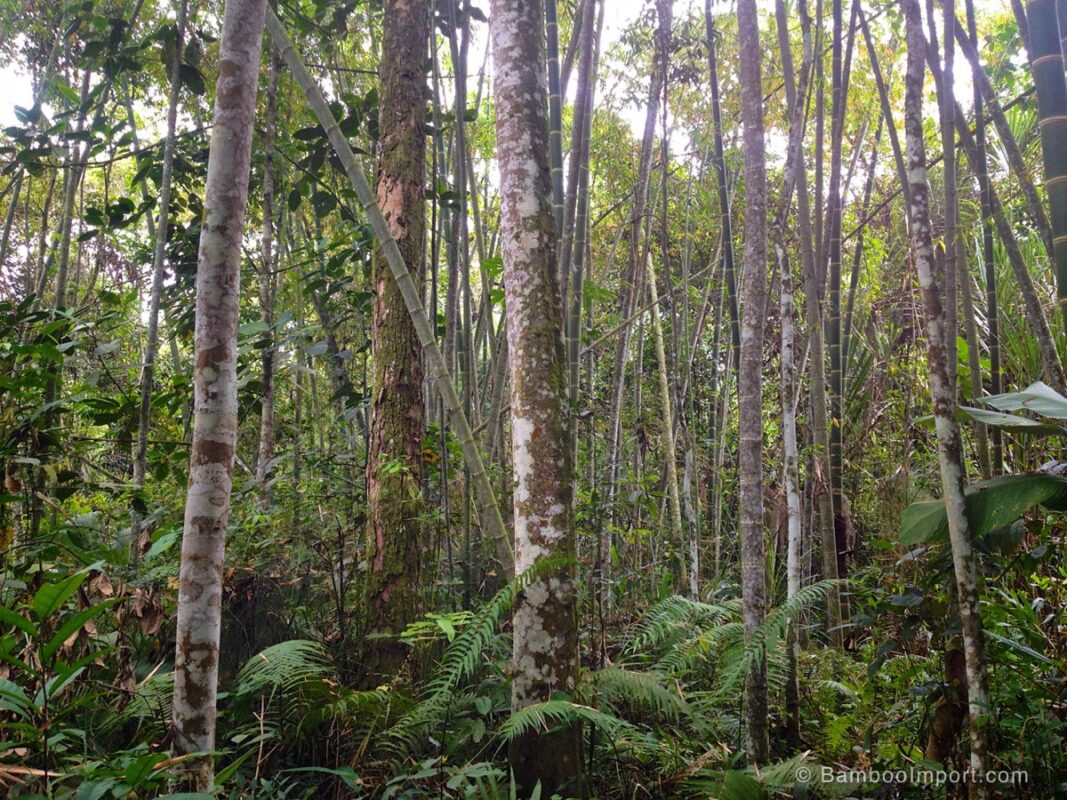
Although bamboo is a grass, many of the larger woody bamboo species are very tree-like and often look like “bamboo trees”. There are, however, a few important differences between grasses and trees.

A mixed forest with bamboo stands and trees. Can you tell which is which?
Bamboo lacks a vascular cambium layer and meristem cells at the top of the culm (stem). The vascular cambium is the ever-growing layer beneath a tree trunk’s bark that causes a tree to increase in diameter every year. The meristem cells make the tree grow taller every year.
Bamboo, on the other hand, does not increase in diameter or height . A single bamboo culm reaches its full height in just one growing season. It then continues for several years, gradually increasing the number of side branches, but neither grows wider nor taller.
Another important difference is that bamboo does not have bark like trees do; instead, it has protective leaves around the culm (culm sheaths) during its early growth stages.
3. Where does bamboo grow?
Bamboo occurs natively on 5 continents: Africa, Asia, South America, North America and Australia. In other words,every continent except Antarctica and Europe has bamboo . Coincidentally, every continent except Antarctica and Europe also has diamonds.
Bamboo grows in the tropical and subtropical regions of Asia, Africa and Latin America, extending as far north as the southern United States or central China and as far south as Patagonia. It also grows in northern Australia.

Distribution of native bamboo around the world
Bamboo occurs naturally as secondary vegetation in forests, but in some cases it is the dominant vegetation type. This is the case in northeastern India, where bamboo covers many thousands of square kilometres, and on the mountainsides of eastern Africa.
Bamboo can alsotolerate extreme conditions that most plants cannot. Some species can grow from sea level to up to 4,000 m in the Andes and Himalayas, and withstand temperatures far below -20°C.
4. How many bamboo species are there?
The subfamily Bambusoideae consists of both woody and herbaceous bamboo, with a total of1,575 identified species across 111 different genera.

Culms of different bamboo species
Around 100 species are used commercially, of which20 are identified as priority species for those wishing to start a bamboo plantation. Apart from the commercially important species, many attractive ornamental bamboos are grown in nurseries for landscaping purposes.
5. How fast does bamboo grow?

Bamboo comprises many different species, all with unique growth rates and properties. Saying that bamboo grows 1 metre a day is misleading, since not all bamboo species grow that fast. That’s why the species must always be specified.
That said,Guinness World Records states thatthe world record for the fastest-growing plant on Earth belongs to a specific bamboo species that grows up to 91 cm (35″) per day, which is almost 4 cm (1.5″) per hour, or at a rate of 0.00003 km/h (0.0000 mph).
These growth rates can be reached during the shooting season, and when soil and climate conditions are optimal. The time-lapse video below, for example, also mentions a growth rate of up to 1 metre per day for the ChineseMoso bamboo ( Phyllostachys edulis ). Another bamboo species reported to have incredibly fast growth rates is Madake bamboo (Phyllostachys bambusoides ).
6. How big does bamboo grow?
Herbaceous bamboo is usually small, resembles grass, and is only a few centimetres tall, while woody bamboo (depending on the species) can grow up to 30 m tall and 20 cm in diameter, which is why it is often mistaken for “trees”. The bamboo speciesDendrocalamus sinicus is considered the largest bamboo in the world, reaching 40 m in height and 30 cm in diameter.
7. Bamboo survived Hiroshima
An extraordinary example of bamboo’s resilience is the fact that it wasthe only plant to survive the radiation of the atomic bombs in Hiroshima , Japan in 1945. The scorching heat destroyed all trees and other plant life except for one bamboo grove. The grove has since been removed, but culms from it are preserved in a museum in Hiroshima.
8. Does bamboo conduct electricity?

Less than a year after developing the first practical light bulb (1880), Thomas Edison designed a new version that had all the essential features of a modern light bulb: a filament in an evacuated glass bulb with a screw base.
The most critical factor was finding the right material for the filament – the part inside the bulb that glows when an electric current passes through it. Edison tested more than 1,600 materials, including coconut fibre, fishing line, and even hair from a colleague’s beard.
Edison eventually settled on using bamboo fibre for the filament. Edison and his team discovered thatcarbonised bamboo had the capacity to conduct electric current , and that it could last more than 1,200 hours – longer than any other material at the time.
Scientists have built on his work and have now discovered that bamboo charcoal is a natural “nanotube” that can conduct electricity like an extremely thin film deposited on the surface of a glass or silicon substrate.
9. Is Lucky Bamboo really bamboo?

The incredibly popular ornamental houseplant, believed to bring positive energy and prosperity to those who place it in their home or office, is actuallynot at all a bamboo!
Lucky bamboo, which originates from the African continent, is widely cultivated in China and Taiwan and exported around the world. Unlike real bamboo, lucky bamboo grows very slowly, about 10 cm per year. Stalks are usually sold when they are between 10 cm and 100 cm tall.
Although the word ‘Bamboo bamboo’ appears in this plant’s common name, its taxonomic order is completely different from real bamboo. The botanical name for Lucky Bamboo isDracaena braunii (also known asDracaena sanderiana ).
