



 Deutsch
Blog / Tips
How is bamboo wood made?
Jun
Bamboo is a renewable resource that has become one of the leading alternatives to tropical hardwood in recent years. When you see bamboo flooring, kitchen cabinets or cutting boards, you might wonderhow round, hollow bamboo canes are processed into solid bamboo wood.
It is important to note that engineered bamboo can be divided into two main groups: “laminated bamboo ” and “strand woven bamboo ” (or a combination of both). Panels similar to OSB, MDF, particleboard, mat board, etc. are also made from bamboo fibre and bamboo chips, but panels made from strips (laminated) or strands (strand woven) are by far the most widely used in Europe.
Laminated bamboo

Laminated bamboo plywood is made from flat rectangularbamboo strips cut from the bamboo culm. These strips, or “lamellas”, are then glued together either horizontally (flat pressed) or vertically (side pressed).

Because laminated bamboo panels are made up of individual strips, they show less swelling and shrinkage than solid wood panels. However, the way bamboo plywood is constructed affects its strength, flexibility and stability.
For example, a 1-layer laminated bamboo panel breaks more easily across its width than a 3-layer or 5-layer panel. A 5-layer panel is also more stable than a 1-layer or 3-layer panel and is less prone to warping. As a general rule, the more layers, the more stable the bamboo panel.
The number of layers and construction also matter for the appearance of a bamboo panel. For example, flat-pressed bamboo plywood has strongly visible nodes, resulting in a very dramatic appearance. The number of layers can be important when using bamboo plywood for applications where the edges are visible, such as stair treads, tables, kitchen countertops, cabinets, etc.

1) Bamboo harvest
Moso bamboo( Phyllostachys edulis ) is the bamboo species chosen for the production of engineered bamboo panels. This Chinese bamboo is known as thehardest bamboo species in the world and grows on average up to 20 metres tall and 10 cm in diameter.
A bamboo culm reaches its maximum height within a few months and does not grow taller or thicker over time. Over the following 4 years, the fibres “lignify” and gain their extraordinary mechanical properties in terms of hardness, strength and density.
Older bamboo canes of 4-5 years can be harvested from a bamboo plantation on an annual basis, while new shoots emerge from the ground. Bamboo is therefore a highly sustainable resource that does not need to be replanted after harvesting. This is, of course, in stark contrast to tropical hardwood, which often requires 50-100 years to reach maturity.

2) Selecting bamboo canes
Bamboo canes with an average diameter of 9 cm are selected for the production of engineered bamboo products. These are cut into lengths of 250 cm.

3) Splitting bamboo canes
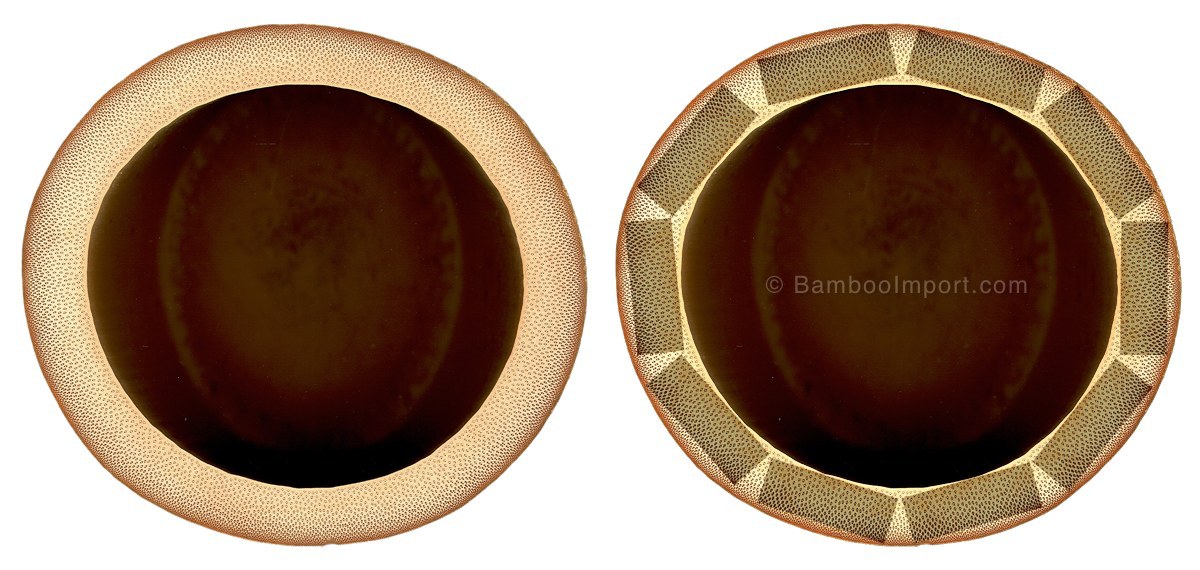
The bamboo canes are placed in a special machine that converts them into rough bamboo strips. The canes are pushed through a metal “splitter” (star-shaped blades) until the entire culm has been cut into lamellas.


4) Planing bamboo lamellas
The bamboo strips are initially still very irregular in shape and structure. To remove their green outer layer and internal nodes, the lamellas are planed down to a size of 22 x 6 mm.

5) Boiling bamboo lamellas
To protect the bamboo against future insect attacks or fungi, the lamellas are boiled in hydrogen peroxide for ± 7 hours. This treatment has the additional benefit of bleaching the strips, resulting in a uniform natural colour.

6) Carbonisation
Optionally, bamboo strips are carbonised in a high-pressure vessel for several hours. The combination of heat and pressure releases natural starch in the bamboo strips, giving it a typical brown caramel colour.

7) Drying and sanding
After the boiling/carbonising treatment, bamboo strips are dried in an oven for about 5 days until they reach a moisture content of approximately 8-10%. Once dry, the bamboo strips are sanded to their final dimensions of 20 x 5 mm.

8) Quality control of bamboo strips
After the bamboo strips have been treated, dried and sanded, they are checked one final time for colour and quality before being processed into panels.

9) Flat pressed
As mentioned earlier, bamboo strips can be glued together either horizontally or vertically. In a “flat pressed” panel, the bamboo strips are pressed together with the front side facing up. This results in a single layer where the pattern and characteristic bamboo nodes are clearly visible.
Flat-pressed bamboo plywood has a thickness of 5 mm. To produce thicker panels, several layers are glued together (usually crosswise).


10) Side pressed
In a “side pressed” panel, the bamboo strips are pressed together vertically. This results in a single layer where the pattern and characteristic bamboo nodes are not clearly visible.
Side-pressed bamboo plywood has a thickness of 20 mm. To produce thicker panels or beams, several layers are glued together.


11) Cutting to size
A band saw is used to convert the 20 mm side-pressed plywood into thinner panels. This way, the individual sheets can be used to build 3-, 5-, 7- or 9-layer bamboo panels.

12) Sanding
Sanding is the final step in the production process to achieve a perfectly flat and smooth surface.

13) Quality control
All bamboo panels undergo a final inspection for production defects during packaging.
Strand woven bamboo
For strand woven bamboo, largely the same steps apply as for laminated bamboo, except that the strips are not glued together horizontally or vertically. Instead, raw bamboo strands are used, which are compressed under high pressure to create a new “composite” material.

The density of strand woven bamboo is much higher than that of laminated bamboo, at 1,200 kg/m3 instead of 700 kg/m3. This also makes strand woven bamboo much harder than laminated bamboo, with a Janka hardness of 2,800 lbf instead of 1,380 lbf.
The appearance of strand woven bamboo is completely different from bamboo plywood. Strand woven bamboo resembles wood, with its flamed grain and bamboo nodes that become almost invisible.

1) From strips to strands
After boiling or carbonising the bamboo strips as described earlier in steps 5-6, the strips are crushed into coarse, fibrous bamboo strands.


2) Impregnating bamboo strands
The bamboo strands are impregnated with glue before being placed in the press.

3) Compression
The bamboo strands are placed in a solid industrial press and compressed with a pressure of 2,500 tonnes.


4) Cutting to size
Strand woven bamboo panels are available in a maximum thickness of 20 mm, otherwise they would become too heavy. Panels 30-40 mm thick are sawn into smaller boards with a width of 10-30 cm. These bamboo planks can then be processed into bamboo flooring, decking boards or side rails.
Are you also interested in working with engineered bamboo? Order yourbamboo panels today in our online shop!
