



 Deutsch
Blog / Tips
What are the mechanical properties of bamboo?
Jun
What are the mechanical properties of bamboo?This is probably one of the most frequently asked questions among European or American architects, engineers and builders. Such information can easily be found for wood, steel, concrete or even engineered bamboo products such as flooring and panels, but this is not the case for bamboo canes.Why?
“Bamboo’s mechanical properties are often two to three times higher than traditional timber. However, legal uncertainties surrounding universal rules and standards are holding back a bamboo boom in many parts of the world.”
Bamboo comprises many different species, and each of these bamboo species has different structural and mechanical properties, just like trees – teak, oak or balsa don’t have the same properties either. Moreover, a single bamboo species can show very different test results depending onthe age andmoisture content of the tested bamboo cane, itsorigin (soil, altitude, climate conditions) and thepart of the culm being tested (bottom, middle or top part of the “tree”).
Another important reason for the lack of information is the fact that bamboo cane as a building material is still relatively unknown in Europe or North America (partly because primary construction-grade bamboo grows in tropical countries). Only in the last 30-35 years have the mechanical properties of bamboo been scientifically tested.
Why are mechanical properties important?

Most countries have no standard building codes for bamboo, which makes it difficult for those wishing to use the material in construction. There is a kind of legal uncertainty surrounding the determination of certain bamboo properties, such as fire resistance, strength properties, durability, etc., which means there is an urgent need for rules and standards.
Strength properties of bamboo have already been tested by universities around the world and show outstanding results that, in many cases, are far better than conventional building materials. However, building code standards require more than strength properties alone; other properties to consider are:
- Durability
- Fire safety
- Environmental impact
- User safety
- Energy efficiency
Fire resistance and durability are areas that still need further research before a standard building code for bamboo can be established. Nevertheless, important progress has been made with the introduction of an internationalISO 22157 standard for the mechanical properties of bamboo.
The International Organization for Standardization (ISO)
The International Organization for Standardization, known as ISO, developed its own standard for determining the mechanical properties of bamboo in 2004. This is a first and very important step towards getting bamboo canes recognised as a building material everywhere.
The ISO 22157 standard describes how bending strength, compression, tension, shear and durability should be determined. For those interested, the guidelines can be foundhere.
In this article, we present several test results from different sources and on different bamboo species. It is important to note that not all tests were carried out in accordance with the ISO 22157 standard, but it does provide a general idea of the mechanical properties of bamboo.
Compressive strength

There are two types of compressive strength to be tested according to the ISO 22157 standard: compressive strength parallel to the grain and compressive strength perpendicular to the grain. Curiously, the ISO 22157 guidelines only describe the test methodology for compressive strength parallel to the grain, but do not provide a method for compressive strength perpendicular to the grain. We will therefore only discuss the former.
Due to the natural shape of a bamboo “tree”, 3 different parts of the culm must be tested: the bottom, the middle and the top part. This is necessary because a bamboo culm does not have a continuous cross-section, and there are differences in structural properties between the lower part, which has a larger diameter, and the upper part, which has a smaller diameter.
Test samples must not contain a node, because the results of such samples would not provide accurate results, as the nodes are the strongest areas of a bamboo culm. Samples are therefore taken from the section between two nodes (internode), as this is the weakest part of a bamboo cane.
For structural purposes, only the bottom, middle and top parts can be used as columns or beams. The “tip” and “stick” part of the bamboo culm are not considered useful in construction due to their small diameter.
Compressive strength of Guadua angustifolia
The mechanical properties of the species Guadua angustifolia were tested in accordance with ISO 22157 standards atLos Andes University in Bogotá, Colombia in 2010. Three samples of 2-, 3-, 4- and 5-year-old Guadua bamboo were used to determine the influence of age on its mechanical properties.

The average moisture content of the bamboo samples (an important parameter) was 59.3%, 56.5%, 56.7% and 65.2% respectively. The average outer diameter of the bottom part was 13 cm, of the middle part 12 cm, and 10 cm for the top part.
| Compressive strength of Guadua angustifolia | |||||
|---|---|---|---|---|---|
| Age of bamboo canes (years) | |||||
| 2 | 3 | 4 | 5 | ||
| Bottom | E (N/mm2) | 15500 | 16500 | 17400 | 15200 |
| σ (N/mm2) | 39,9 | 38,1 | 37.6 | 32,1 | |
| Middle | E (N/mm2) | 14900 | 18000 | 16800 | 16500 |
| σ (N/mm2) | 27.2 | 42,1 | 41,5 | 34,7 | |
| Top | E (N/mm2) | 20000 | 17000 | 17500 | 18200 |
| σ (N/mm2) | 20,4 | 42,6 | 42,1 | 39,0 | |
The maximum compressive strength for Guadua angustifolia was observed in 3-4-year-old culms, with an average of40 N/mm2 (in a green state). The compressive strength of 5-year-old Guadua decreased by approximately 16% compared to the strength of 3-4-year-old Guadua.
Comparison of compressive strength for different bamboo species
The following table provides an overview of the compressive strength of different bamboo species. It is important to note that not all test results comply with the ISO 22157 standard. The values shown in the table are average values, so they do not indicate differences in vertical direction or age.
| Compressive strength of different bamboo species | |||||
|---|---|---|---|---|---|
| Species | σ (N/mm2) | E (N/mm2) | ρ (kg/m3) | MC (%) | Source |
| Bambusa balcooa | 39,4 – 50,6 | – | – | green | Kabir et al. |
| 51 – 57,3 | – | – | air-dried | ||
| 69 | – | 820 | 8.5 | Naik | |
| Bambusa bambos | 61 | – | 710 | 9.5 | |
| 39,1 – 47 | – | – | – | Gnanaharan | |
| Bambusa nutans | 75 | – | 890 | 8 | Naik |
| 46 | – | – | 87 | Sekhar | |
| 85 | – | – | 12 | ||
| 44,7 | – | – | 88.3 | Inbar | |
| 47,9 | – | – | 14 | ||
| Bambusa pervariabilis | 45,8 | 15200 | – | – | Yuen |
| 79 | 10300 | – | <5 | Yu & Chung | |
| 35 | 6800 | – | > 20 | ||
| Bambusa polymorpha | 32,1 | – | – | 95,1 | Inbar |
| Bambusa spinosa | 57 | – | – | – | Espinosa |
| Bambusa tulda | 40.7 | – | – | 73,6 | Inbar |
| 68 | – | – | 11.9 | ||
| 79 | – | 910 | 8.6 | Naik | |
| Dendrocalamus giganteus | 70 | – | 740 | 8 | |
| Dendrocalamus hamiltonii | 70 | – | 590 | 8.5 | |
| Dendrocalamus membranaceus | 40.5 | – | – | 102 | Inbar |
| Gigantochloa apus | 21,7 – 26,5 | – | – | 54.3 | |
| 27,3 – 48,6 | – | – | 15.1 | ||
| Gigantochloa atroviolacea | 23.8 | – | – | 54 | |
| 35,7 | – | – | 15 | ||
| Gigantochloa atter | 24,8 – 28 | – | – | 72,3 | Prawirohatmodjo |
| 31 – 32,9 | – | – | 14.4 | ||
| Gigantochloa macrostachya | 71 | – | 960 | 8 | Naik |
| Guadua angustifolia | 42 | 27000 | – | – | Sotela |
| 63,6 | – | – | – | RWTH Aachen | |
| 86,3 | – | – | – | ||
| 62 – 93 | – | – | – | DB Magazine | |
| 56 | 18400 | – | 15 | Eicher | |
| 63,3 | 15190 | – | – | Laroque | |
| 28 | 15000 | – | – | Trujillo | |
| 56,2 | 17860 | – | – | Caori | |
| 38 | 14500 | – | – | Uribe | |
| Melocanna baccifera | 69.9 | – | – | 12.8 | Inbar |
| Phyllostachys bambusoides | 51 | – | – | – | Glenn |
| 63 | – | 730 | 8 | Naik | |
| 44 | – | – | 64 | Limaye | |
| 40 | – | – | 61 | ||
| 71 | – | – | 9 | ||
| 74 | – | – | 9 | ||
| 54 | – | – | 12 | Sekhar | |
| Phyllostachys edulis | 44,6 | 11300 | – | – | Yen |
| 67 | – | – | 50 – 99 | Ota | |
| 71 | – | – | 14 – 17 | ||
| 108 | – | – | 5 – 7 | ||
| 147 | – | – | 0,1 – 0,3 | ||
| 117 | 9400 | – | <5 | Yu & Chung | |
| 44 | 6400 | – | > 30 | ||
| 60.3 | – | 603 | 12.5 | Kaho | |
| Phyllostachys praecox | 79,3 | – | 827 | 28,5 | |
| Thyrsostachys oliveri | 46,9 | – | – | 53 | Inbar |
| 58 | – | – | 7.8 | ||
Conclusion:
Bamboo’s compressive strength is roughly located between40 and 80 N/mm2, which istwo to four times the value of most wood species . The difference in results can be explained by the different test methods and samples used. However, it is clear that the age and moisture content of bamboo samples have a significant influence on bamboo’s compressive strength. Bamboo with low moisture content has ahigher compressive strength than bamboo with high moisture content.
Tensile strength
The maximum tensile strength of bamboo is determined by testing the fibres (bamboo strips) rather than whole culm samples. As with compressive strength, the ISO 22157 standard provides guidelines for tensile strength parallel to the grain, but not for tensile strength perpendicular to the grain.
To test bamboo’s tensile strength, 3 strips are taken from the bottom, middle and top parts of the entire bamboo culm. Each strip is between 10-20 mm wide, has the thickness of the bamboo culm wall, and is 100 mm long. The moisture content of each sample must be determined, and the samples must contain a node. Since the fibre direction of the node is opposite to the fibre direction internally, the node is considered the weakest point of the culm here (when testing compressive strength, it is the opposite).
The following table shows the tensile strength of the most popular bamboo species used for structural applications.
| Tensile strength of different bamboo species | |||||
|---|---|---|---|---|---|
| Species | σ (N/mm2) | E (N/mm2) | ρ (kg/m3) | MC (%) | Source |
| Bambusa balcooa | 164 | – | 820 | 8.5 | Naik |
| Bambusa bambos | 121 | – | 710 | 9.5 | |
| Bambusa nutans | 208 | – | 890 | 8 | |
| Bambusa tulda | 207 | – | 910 | 8.6 | |
| Dendrocalamus giganteus | 177 | – | 740 | 8 | |
| Dendrocalamus hamiltonii | 177 | – | 590 | 8.5 | |
| Dendrocalamus strictus | 160 | 17500 | – | 11.4 | Janssen |
| Gigantochloa apus | 294,1 | – | – | 54.3 | Prawirohatmodjo |
| 298,9 | – | – | 15.1 | ||
| Gigantochloa atroviolacea | 237,4 | – | – | 54 | |
| 237,4 | – | – | 15 | ||
| Gigantochloa atter | 273 – 299,8 | – | – | 72,3 | |
| 247 – 332 | – | – | 14.4 | ||
| Gigantochloa macrostachya | 168 | – | 960 | 8 | Naik |
| Gigantochloa pseudoarundinacea | 177,9 | 27631 | 690 | – | Arce-Villalobos |
| 149,4 | 19643 | 629 | – | ||
| Guadua angustifolia | 148 – 384 | – | – | – | DB Magazine |
| 191,9 | – | – | – | Lopez | |
| 90 | – | – | – | Trujillo | |
| 162,7 | 17900 – 24100 | – | – | Laroque | |
| Phyllostachys bambusoides | 140 | – | 730 | 8 | Naik |
| 120 | – | – | 12 | Janssen | |
| Phyllostachys edulis | 115 – 309 | 8987 – 27397 | 553 – 1006 | 4,9 – 7,8 | Yu |
Conclusion:
The average tensile strength of bamboo is approximately160 N/mm2, which is often3 times higher than most traditional construction-grade timber .
Shear strength
The maximum shear stress of bamboo is an important factor in designing appropriate joinery and connections. Shear stresses can occur in two ways: parallel to the grain and perpendicular to the grain. Again, the ISO 22157 standard only provides guidelines for measuring shear stress parallel to the grain.
Three samples from the bottom, middle and top parts of the bamboo culm are tested. The difference this time is that half of the test samples must contain a node, and the other half must not.
Each sample is carefully measured before testing. The height of the test piece and the thickness of the culm wall are measured in the 4 zones where shear will occur. This is important because a bamboo culm is not uniform in thickness, and the sample cross-cuts may not be made perfectly.
Shear strength of Guadua angustifolia
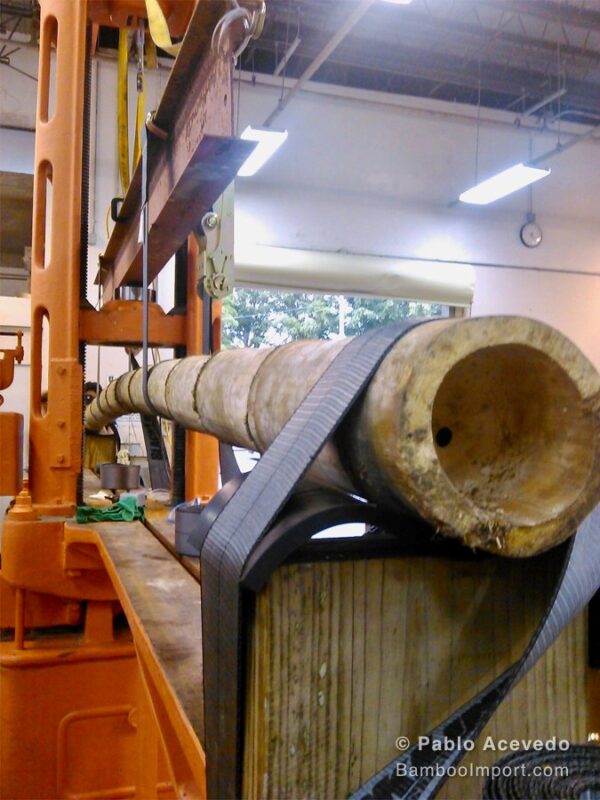
In the same way that they tested the compressive strength of Guadua angustifolia,Los Andes University in Bogotá they also examined the same Guadua samples for shear stress in accordance with the ISO 22157 standard.
A few pictures of the test setup are shown below:

The shear strength of Guadua angustifolia depending on the age and position of the test sample is shown in the following table:
| Shear strength of Guadua angustifolia | |||||
|---|---|---|---|---|---|
| Age of bamboo canes (years) | |||||
| 2 | 3 | 4 | 5 | ||
| Bottom | τ (N/mm²) | 7.2 | 7.4 | 7.5 | 6.6 |
| Middle | τ (N/mm²) | 7.5 | 8.2 | 8,0 | 7.4 |
| Top | τ (N/mm²) | 7.2 | 8.1 | 7.6 | 8,0 |
Similar to the compressive strength results, Guadua offers the most resistance to shear in the middle and upper part of a 3-4 year old stem sample. The average shear strength of Guadua angustifolia is8 N/mm² (at a moisture content of approximately 56.6%).
Comparison of shear strength for different bamboo species
The shear strength of different bamboo species is listed in the table below. Again, we cannot confirm that all testing was carried out in accordance with the ISO 22157 standard, but it provides a general insight.
| Shear strength of different bamboo species | ||||
|---|---|---|---|---|
| Species | τ (N/mm²) | ρ (kg/m3) | MC (%) | Source |
| Bambusa balcooa | 11.9 | 820 | 8.5 | Naik |
| Bambusa bambos | 9.9 | 710 | 9.5 | |
| Bambusa nutans | 10.5 | 890 | 8 | |
| 6.7 | – | – | Sekhar | |
| 7.7 | – | – | ||
| 7.9 | – | – | ||
| 9.8 | – | – | ||
| 7.9 | – | – | ||
| Bambusa pervariabilis | 10.3 | – | 12 | Janssen |
| 8.7 | – | 12 | ||
| Bambusa tulda | 9.9 | 910 | 8.6 | Naik |
| Dendrocalamus giganteus | 10.6 | 740 | 8 | |
| Dendrocalamus hamiltonii | 6.7 | 590 | 8.5 | |
| Gigantochloa apus | 6 – 7,7 | 54.3 | Prawirohatmodjo | |
| 7,5 – 7,7 | 15.1 | |||
| Gigantochloa atroviolacea | 6,4 – 11,3 | 54 | ||
| 7,9 – 9,5 | 15 | |||
| Gigantochloa atter | 5,8 – 10,8 | 72,3 | ||
| 9,5 – 10,8 | 14.4 | |||
| Gigantochloa macrostachya | 9.6 | 960 | 8.1 | Naik |
| Guadua angustifolia | 4 – 5 | – | – | Trujillo |
| 16.7 | – | – | RWTH Aachen | |
| Phyllostachys bambusoides | 8.7 | 730 | 8 | Naik |
| Phyllostachys edulis | 8,9 – 12,5 | – | 12.5 | Ota |
| 8.9 | – | green | Dickerson | |
Conclusion:
Shear stress parallel to the grain is approximately 10 times lower than compressive strength, and even 20 times lower than the tensile strength of the same bamboo species. Still, the shear strength of bamboo is oftentwice as high as the value for popular timber species .
Bending strength
Bending strength has a direct influence on the construction of a structure; it’s necessary to predict the deflection of every element in a structure before it is built. The most commonly used method for determining the deflection of a beam or column is the four-point bending test.
Bending strength of Guadua angustifolia
The four-point bending test, as required by the ISO 22157 standard, was carried out atLos Andes University in Colombia . The testing was carried out on the same bamboo poles as in the test for determining compressive and shear strength.

During this four-point bending test, the modulus of elasticity (MOE) and modulus of rupture (MOR) are examined. The results of this test are shown in the following table.
| Bending strength of Guadua angustifolia | |||||
|---|---|---|---|---|---|
| Age of bamboo canes (years) | |||||
| 2 | 3 | 4 | 5 | ||
| Bottom | MOE (N/mm²) | 16900 | 16700 | 17000 | 18000 |
| MOR (N/mm²) | 93,6 | 88.8 | 86,9 | 86,3 | |
| Middle | MOE (N/mm²) | 17700 | 15800 | 17000 | 18700 |
| MOR (N/mm²) | 84,7 | 91,6 | 103,7 | 86,9 | |
| Top | MOE (N/mm²) | 16100 | 19400 | 18300 | 15500 |
| MOR (N/mm²) | 107,3 | 97,8 | 103,8 | 107,0 | |
The modulus of elasticity of 5-year-old Guadua angustifolia poles is greatest in the bottom and middle part of the stem. For the top part of the stem, the highest modulus of elasticity is measured when the poles are 3-4 years old. The modulus of rupture is highest in the top part of the stem. In general, it can be concluded that Guadua angustifolia has an average bending strength of100 N/mm² .
Comparison of bending strength of different bamboo species
The following table summarizes the bending strength of several bamboo species. The results may show slight deviations, because not all data was obtained using the four-point bending test as defined in the ISO 22157 standard. Nevertheless, they provide a general idea of the bending strength of different bamboo species.
| Bending strength of different bamboo species | |||||
|---|---|---|---|---|---|
| Species | MOR (N/mm²) | MOE (N/mm²) | ρ (kg/m3) | MC (%) | Source |
| Bambusa balcooa | 62,4 – 85 | 7200 – 10300 | – | green | Kabir et al. |
| 69,6 – 92,6 | 9300 – 12700 | – | air-dried | ||
| 151 | 13603 | 820 | 8.5 | Naik | |
| Bambusa bambos | 143 | 14116 | 710 | 9.5 | |
| 35 – 39,3 | 1500 – 4400 | – | – | Gnanaharan | |
| Bambusa nutans | 52,9 | 6700 | – | 88.3 | Inbar |
| 52,4 | 10700 | – | 14 | ||
| 56 – 79 | 8800 – 10000 | – | green | Sekhar | |
| 76 – 100 | 9300 – 16000 | – | air-dried | ||
| 216 | 20890 | 890 | 8 | Naik | |
| Bambusa pervariabilis | 37 | 16400 | – | > 20 | Yu & Chung |
| 80 | 22000 | – | <5 | ||
| Bambusa polymorpha | 28.3 | 3100 | – | 95,1 | Inbar |
| 35.5 | 4100 | – | 13.9 | ||
| Bambusa spinosa | 55,4 | – | – | air-dried | Espinosa |
| 44,9 | – | – | air-dried | ||
| 55 | 10300 | – | air-dried | Teodoro | |
| Bambusa tulda | 51,1 | 800 | – | 73,6 | Inbar |
| 66,7 | 1000 | – | 11.9 | ||
| 194 | 18611 | 910 | 8.6 | Naik | |
| Dendrocalamus giganteus | 193 | 16373 | 740 | 8 | |
| Dendrocalamus hamiltonii | 89 | 9629 | 590 | 8.5 | |
| Dendrocalamus membranaceus | 26,3 | 2400 | – | 102 | Inbar |
| 37,8 | 3700 | – | 7 | ||
| Dendrocalamus strictus | 68 | 12000 | – | green | Limaye |
| 107 | 15600 | – | air-dried | ||
| 92 – 97 | 13700 – 16000 | – | 12 | ||
| 105 | 13200 | – | 61 | ||
| 98,5 | 13600 | – | 55 | ||
| Gigantochloa apus | 102 | – | – | 54.3 | Prawirohatmodjo |
| 87,5 | – | – | 15.1 | ||
| Gigantochloa atroviolacea | 92,3 | – | – | 54 | |
| 94,1 | – | – | 15 | ||
| Gigantochloa atter | 87,9 – 108,1 | – | – | 72,3 | |
| 117,7 – 127,7 | – | – | 14.4 | ||
| Gigantochloa macrostachya | 154 | 14226 | 960 | 8 | Naik |
| Guadua angustifolia | 53,5 | 7400 | – | – | Gnanaharan |
| 144,8 | 17600 | – | – | Janssen | |
| 74 – 100 | 17900 | – | 15 | Eicher | |
| 46 | 11800 | – | – | Trujillo | |
| 82 | 12500 | 600 | 12.6 | De Vos | |
| 72,6 | 17608 | 640 | 11.4 | Inbar | |
| Melocanna baccifera | 57.6 | 12900 | – | 12.8 | |
| Phyllostachys edulis | 55 | 9600 | – | > 30 | Yu & Chung |
| 51 | 13200 | – | <5 | ||
| 83 | 8400 | 530 | 10.3 | De Vos | |
| Thyrsostachys oliveri | 61,9 | 9700 | – | 53 | Inbar |
| 90 | 12200 | – | 7.8 | ||
Conclusion:
The bending strength of most bamboo species varies between50 and150 N/mm² and averagestwice as strong as most conventional timber structures . Variations within the same species are caused by different test methods, sample quality, and the moisture content of the bamboo tested.
